Difference Between Jaw crusher and Cone crusher
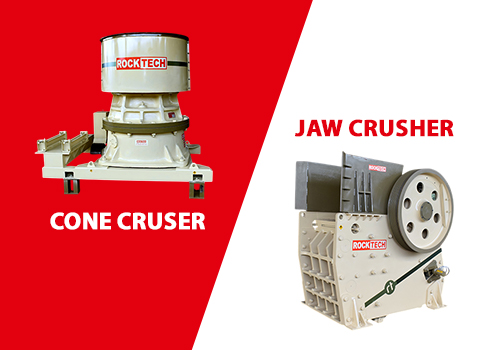
Crushers are essential equipment across industries like mining, construction and aggregates. There are a myriad types of crushers in the market however jaw and cone crushers stand out for their enhanced efficiency and better outcomes. Although both are engineered to break down large rocks into desired sizes, they vary in use, methods and efficiency. Jaw crusher is predominantly used to break down large, hard rocks. Whereas a cone crusher is used for secondary or tertiary crushing, offering finer, smoother particles for further use. Whether to choose a jaw or cone crusher can seem overwhelming but this blog post will guide you through jaw vs cone crusher, their applications and key features.
What is a Jaw Crusher?
Jaw crusher is a primary crushing device used to reduce large and hard rocks to smaller sizes. It involves the use of two jaws, one fixed and the other moving, which squash materials against each other with tremendous force. Jaw crushers are ideal in initial size reduction, which involves heavy work such as mining and quarrying. They are dependable, simple to maintain and are suited to handle hardened, rough materials.
Key Features of a Jaw Crusher
- High Feed Capacity : It can handle oversized, hard rocks and abrasive materials.
- Simple Design : It is easy to use and maintain with minimal design.
- Durability : It is built with a robust design and can work in rough environments.
- Coarse Output : It delivers coarse materials for further processing.
- Versatility : It is useful for both stationary and mobile crushing plants.
Applications of Jaw Crushers
- Mining Industry : It is used to break down ores like iron ore, gold ore or copper ore.
- Construction : It is used to crush rocks for roads, buildings and concrete.
- Quarrying : It grinds larger rocks into smaller manageable sizes for further processes.
- Recycling : It recycles demolition waste, concrete blocks and construction debris.
What is a Cone Crusher?
A cone crusher is a secondary or tertiary crushing device used to create finer or smoother material compared to a jaw crusher. It operates by crushing material in between a rotating mantle and a hollow bowl, progressively decreasing the size of the rocks. Cone crushers are suitable for medium to hard materials.
Key Features of a Cone Crusher
- Secondary/ tertiary crushing : It is often used for refining materials after their primary crushing process.
- High-volume capacity : It functions with ease even in large volume situations.
- Adjustable output : It is a flexible tool, output can be controlled by adjusting crusher setting.
- Consistent : It maintains consistency and uniformity even under heavy workloads.
- Versatility : It can handle medium to hard rocks, ores, minerals, etc.
Applications of Cone crusher
- Finer output : It produces finer smoother output for further use.
- Construction projects : It offers ready-to-use materials for roads, buildings, etc.
- Refinement : It refines raw materials for chemical, industrial or metallurgical products.
- Secondary and tertiary crushing : It is frequently used to crush already crushed material after its primary crushing process.
Key Differences Between a Jaw Crusher and a Cone Crusher
Jaw crusher
- Stage of use : it is used for primary crushing, it’s the first step to break down large rocks
- Feed size : it can handle heavy and large material from 650 to 1200mm
- Output size : produces coarser output compared to a cone crusher
- Operation cost it is inexpensive with a simple design and easy to maintain
Cone crusher
- Stage of use : mostly used for secondary or tertiary crushing, often after a jaw or primary crusher
- Feed size : it can handle 35 to 300mm material size
- Output size : produces finer and smoother output
- Operation cost : it is expensive compared to a jaw crusher due to more wear parts and energy usage
Conclusion
Jaw and cone crushers complement each other in the crushing equipment industry. Jaw crusher can break big, hard materials into smaller pieces. Cone crushers are used in the secondary and tertiary crushing stages, producing fine, homogenous aggregates that can be used in concrete, asphalt, and other construction projects. Both are commonly utilized in mining, quarrying, and industry, and the appropriate choice of the required crasher is based on the hardness of the material, the feed size, and the output. Operating jaw and cone crushers together enable their operators to optimize performance, minimize operational expenses, and create quality and consistent material. The knowledge of the disparities among these crushers would help businesses to make sound choices, streamline their crushing processes, and remain productive in all stages of material processing.